

If you look up at the night sky, the stars seem incredibly far away. They feel unreachable and distant, cold and beautiful. Now, imagine looking at those same stars while standing ankle-deep in mud, your back aching from hours of picking cucumbers or sugar beets under the hot California sun. This is not just a metaphor for a difficult life because this was the actual reality for José M. Hernández. His story is one of the most compelling narratives of the American Dream that I have ever come across. It is a story that takes us from the humble agricultural fields of the San Joaquin Valley all the way to the International Space Station.
Most of us know him now because of the popular movie A Million Miles Away, but the real life of José Hernández is even more detailed and inspiring than what can be fitted into a two-hour film. It is a masterclass in grit. When we talk about success, we often think of people who are naturally gifted or born into wealth, yet José had neither of those advantages. He had to fight for every inch of progress. In this article, I want to take a deep dive into his life, not just listing dates and facts, but exploring the mindset that allowed a boy who didn’t speak English until he was twelve to eventually fly the Space Shuttle Discovery.
Roots in the Soil: The Early Years
To understand the man, you have to understand where he came from. José was born into a family of migrant farmworkers. For those who might not be familiar with this lifestyle, it involves a grueling schedule of constant movement. His family would spend months in Mexico and then travel north to California to follow the harvest seasons. They moved from Stockton to Fresno to other parts of the state, chasing crops like strawberries, cucumbers, and cherries. This meant that José and his siblings were constantly changing schools. It is hard enough to learn math and history when you are in one place, but imagine trying to learn when you miss months of school at a time and have to make new friends every few weeks.
Despite these hardships, his childhood was filled with love and strong values. His father, Salvador, was a stern but wise man who taught José a lesson that would define his entire life. One day, after a particularly hard day of labor, his father sat him down in the family car. He gave José a “recipe” for success. It wasn’t a complex secret. It consisted of five ingredients: find your goal, know how far you are from it, draw a roadmap to get there, prepare yourself with education, and finally, work harder than anyone else. That conversation in a dusty car changed everything. It gave José a framework to view his life not as a series of unfortunate events, but as a solvable engineering problem.
We also cannot overlook the importance of his teachers. There is a famous story about his second-grade teacher, Ms. Young, who actually went to visit José’s parents at their home. She convinced them that for the children to succeed, they needed stability. She urged them to stop moving the family back and forth to Mexico so often during the school year. That intervention was crucial. It allowed José to finally stay in one place long enough to learn English properly, though he didn’t become fluent until he was about twelve years old. This shows that success is rarely a solo act; it often requires the support of parents and educators who care enough to intervene.
The Dream Takes Shape
The dream of going to space didn’t just appear out of nowhere. It struck José like a lightning bolt in 1972. He was adjusting the rabbit-ear antenna on his family’s old black-and-white television set when he saw Gene Cernan walking on the moon during the Apollo 17 mission. But the real connection happened later when he heard about Franklin Chang-Díaz. Chang-Díaz was the first Hispanic-American astronaut selected by NASA. When José heard that a man who shared his heritage and spoke his language was going to space, the impossible suddenly seemed possible. He realized that the gap between the fields and the stars could be bridged.
Education became his primary tool for building that bridge. He leaned heavily into mathematics and science because numbers are a universal language. Even if his English wasn’t perfect yet, an equation was the same in English as it was in Spanish. He worked relentlessly, eventually earning a spot at the University of the Pacific in Stockton to study electrical engineering. Later, he earned a full scholarship to the University of California, Santa Barbara, for his master’s degree. This period was not easy. He often felt out of place, suffering from what we now call “imposter syndrome,” wondering if a farm boy really belonged in the high-tech halls of academia.
But he did belong. In fact, he excelled. Before he ever put on a spacesuit, José made a massive contribution to medical science. While working at the Lawrence Livermore National Laboratory, he co-developed the first full-field digital mammography imaging system. This technology was crucial for the early detection of breast cancer. It is amazing to think that even if he had never made it to NASA, he would still be a hero for his work in engineering that has saved countless lives. This part of his life reminds us that the journey toward a big dream often produces incredible side benefits for the world.
The Art of Not Giving Up: 11 Rejections
This is perhaps the most famous part of José’s story, and for good reason. It is the part that resonates most with anyone who has ever failed. José applied to NASA’s astronaut training program with high hopes. He waited for the letter, tore it open, and found a rejection. He applied again. Rejection. He applied a third time. Rejection. This cycle continued for over a decade. In total, NASA turned him down eleven times. I want you to pause and think about that. Most people would give up after two or three tries. They would tell themselves that it wasn’t meant to be, or that the system was rigged against them.
But José approached these rejections with the mind of an engineer. He didn’t just get sad; he got analytical. He looked at the resumes of the people who did get selected. He noticed a pattern. The successful candidates weren’t just engineers; they were pilots, they were scuba divers, they spoke foreign languages. He realized he was competing against super-achievers. So, he decided to become one himself. He didn’t just wait for the next application cycle. He used the time to upgrade his own “operating system.”
He went out and obtained his pilot’s license. He became certified in scuba diving. He realized that Russia was a major partner in the International Space Station, so he learned to speak Russian. He continued to excel in his engineering career. By the time he applied for the twelfth time, he was no longer the same applicant who had been rejected previously. He was a highly skilled, multi-talented professional who was undeniably qualified. In 2004, the call finally came. He was selected as part of the 19th class of NASA astronauts. The lesson here is profound: rejection is not a stop sign; it is an instruction manual on what you need to improve.
Mission STS-128: A Dream Realized
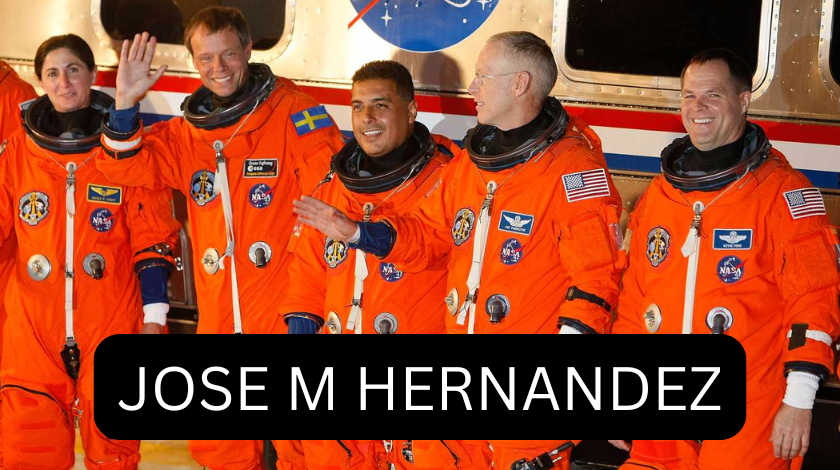
The training to become a mission specialist is grueling. It involves survival training in the wilderness, underwater simulations to mimic zero gravity, and mastering the complex systems of the Space Shuttle. Finally, on August 28, 2009, José M. Hernández strapped himself into the Space Shuttle Discovery for the STS-128 mission. As the engines ignited and the shuttle roared into the sky, he was leaving the planet that he had once worked with his bare hands.
During the mission, which lasted nearly 14 days, José served as a mission specialist. He helped transfer tons of equipment to the International Space Station and operated the robotic arm. One of the most touching moments of the mission was when he sent the first bilingual tweet from space. He wanted to make sure that the people back home in Mexico and the Spanish-speaking community in the US felt included in this journey. He wrote about his hope that we could all work together for a better world.
José has often spoken about the “Overwatch Effect,” a cognitive shift that happens when astronauts see Earth from space. He described looking down at North America. He could see Canada, the United States, and Mexico. But what stood out to him was what he couldn’t see. He couldn’t see borders. He couldn’t see the political lines that divide us. He just saw one beautiful, fragile blue marble hanging in the black void. He realized that we are all just crew members on the same spaceship, Earth. It is a perspective that he has tried to share with everyone since returning to solid ground.
A Million Miles Away: The Movie and Cultural Impact
In 2023, Amazon Prime released the movie A Million Miles Away, starring Michael Peña as José. I believe this movie was incredibly important for cultural representation. For a long time, astronauts in movies were typically depicted as stoic military men from standard backgrounds. Seeing a hero who grew up picking grapes, listening to mariachi music, and eating enchiladas was a validating moment for millions of Hispanic viewers. It showed that the “American Dream” comes in many flavors and backgrounds.
While movies always dramatize certain events for emotional effect, the core of the film remained true to José’s spirit. It highlighted the sacrifices his wife, Adela, made. This is a crucial point that often gets missed. Adela put her own dreams on hold and managed a restaurant while raising their children so José could pursue this insane goal. The movie did a great job of showing that José’s achievement was a family victory, not just an individual one. It brought his story to a new generation who might not read biographies but will watch a streaming movie.
Life After NASA: Full Circle
After leaving NASA in 2011, José did not just retire to play golf. He utilized his skills to start his own aerospace consultancy firm, Tierra Luna Engineering. However, the most poetic part of his post-NASA life is his return to agriculture. He purchased a vineyard near Lodi, California, and started Tierra Luna Cellars. He now produces his own line of wines.
There is a beautiful symmetry to this. He started his life working the land as a laborer, looked up to the stars, traveled to those stars, and then returned to the land—but this time as an owner and a creator. He has come full circle. He often jokes that he is the only astronaut who knows how to prune a grape vine properly. Today, he spends much of his time giving motivational speeches to students, urging them to reach for their own stars. He ran for Congress at one point, showing his desire to serve his community in a different way, although he did not win that particular race.
Conclusion
The life of José M. Hernández serves as a powerful reminder that our beginnings do not dictate our endings. Whether you are a student struggling with grades, a professional facing rejection, or someone who feels that your background holds you back, José’s story offers a blueprint for resilience. He proved that tenacity can overcome almost any obstacle. He taught us that “no” is not a final answer, but rather a challenge to be better.
From the muddy fields of California to the weightlessness of orbit, his journey was fueled by the simple recipe his father gave him: determine your goal, and be willing to work harder than everyone else to get there. As we look at his life, we are reminded that the stars are not reserved for a select few; they are there for anyone willing to build the ladder to reach them.
Frequently Asked Questions (FAQ)
Q: How many times was José Hernández rejected by NASA?
A: José was rejected by NASA eleven times before finally being selected into the astronaut program on his twelfth attempt in 2004.
Q: What is the name of the movie about José Hernández?
A: The movie is titled A Million Miles Away and it was released in 2023, starring Michael Peña as José.
Q: What mission did José Hernández fly on?
A: He flew on mission STS-128 aboard the Space Shuttle Discovery in August 2009.
Q: Did José Hernández invent anything?
A: Yes, while working at Lawrence Livermore National Laboratory, he helped develop the first full-field digital mammography imaging system, which aids in the early detection of breast cancer.
Q: What does José Hernández do now?
A: He runs an aerospace consulting firm called Tierra Luna Engineering and owns a vineyard called Tierra Luna Cellars in California. He is also a motivational speaker.