

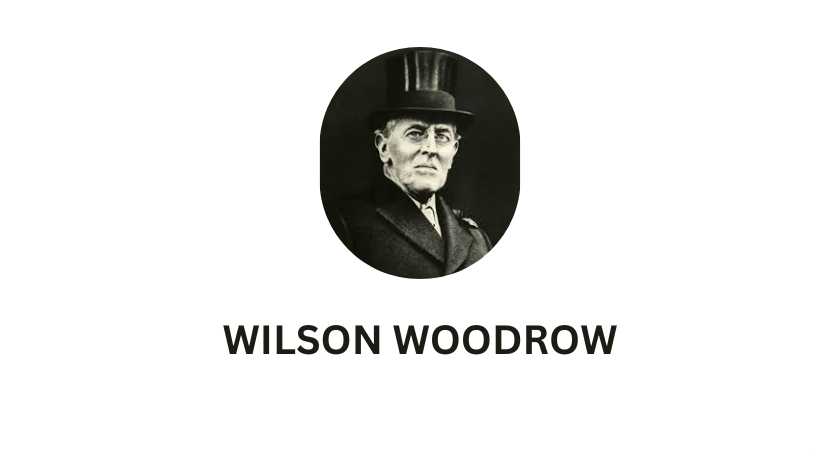
When we look back at the long line of American presidents, many of them seem like larger-than-life warriors or seasoned career politicians. But Woodrow Wilson was different. He was the “Professor President,” a man who seemed more at home in a library than a smoke-filled political room. Yet, his influence on the United States and the entire world was so massive that we are still feeling the ripples of his decisions today. To understand Wilson is to understand the birth of the modern world, both its idealistic hopes and its deeply uncomfortable flaws.
Woodrow Wilson, or Вильсон Вудро as he is known in many historical texts, served as the 28th President of the United States. His journey didn’t start in the military or in local law offices, but in the halls of academia. Before he ever dreamed of the Oval Office, he was the President of Princeton University. This academic background defined everything he did. He believed in systems, in logic, and in the idea that government could be used as a precise tool to fix society’s problems. When he entered the White House in 1913, he brought with him a plan called “The New Freedom,” which aimed to take power away from big monopolies and give it back to the average person.
I have always found Wilson’s domestic policies fascinating because they represent a total shift in how the American economy works. One of his biggest achievements was the Federal Reserve Act. Before this, the American banking system was a bit of a mess, prone to sudden collapses that left regular people broke. Wilson helped create a central banking system that could manage the nation’s money supply. While people debate the “Fed” today, it was a revolutionary step toward stability at the time. He also pushed for the Federal Trade Commission and stronger antitrust laws. He wasn’t just talking about change; he was rewriting the rules of the American marketplace to favor competition over corporate bullying.
However, you can’t talk about Woodrow Wilson without talking about World War I. For the first few years of the “Great War,” Wilson was determined to keep America out of it. He even ran for reelection in 1916 with the slogan, “He kept us out of war.” But history has a way of forcing a leader’s hand. Between the sinking of the Lusitania and the infamous Zimmerman Telegram—where Germany tried to entice Mexico into attacking the U.S.—Wilson realized that neutrality was no longer an option. In 1917, he asked Congress to declare war, famously stating that “the world must be made safe for democracy.” This wasn’t just a military goal for him; it was a moral crusade.
Wilson’s vision for the end of the war is perhaps his most famous contribution to history: The Fourteen Points. He didn’t want the war to end with just a winner and a loser; he wanted a “peace without victory.” He proposed a world where nations could determine their own borders and where a “League of Nations” would settle disputes before they turned into bloody conflicts. To me, this is the ultimate example of Wilson’s idealism. He truly believed that human beings could rise above their tribal instincts and create a global system based on law and cooperation. It was this vision that earned him the Nobel Peace Prize in 1919.
But here is where the story takes a tragic turn. While Wilson was hailed as a savior in Europe, he couldn’t convince his own country to join the League of Nations. The U.S. Senate, led by his rivals, feared that joining such a group would take away America’s sovereignty. Wilson, being the stubborn academic he was, refused to compromise. He went on a grueling cross-country tour to sell the idea to the American people, but the stress was too much. He suffered a massive stroke that left him partially paralyzed. For the remainder of his presidency, he was a shadow of himself, with his wife, Edith, essentially acting as a gatekeeper for the executive branch. It’s a heartbreaking end to a career that was built on the power of the mind.
We also have to be honest about the darker parts of his legacy. It is impossible to discuss Wilson today without addressing his record on race. Despite his “progressive” labels, Wilson oversaw the re-segregation of federal offices in Washington D.C., which had been integrated for decades. He was a man of the South who held deeply racist views that caused real harm to African American families and civil servants. He even famously screened the film The Birth of a Nation—which glorified the Ku Klux Klan—at the White House. This is the great contradiction of Woodrow Wilson: he was a man who wanted to bring democracy to the world but failed to ensure basic dignity and equality for all citizens in his own country.
When I think about Wilson’s impact, I see a man who was both ahead of his time and held back by the prejudices of his era. His “Wilsonian” foreign policy—the idea that the U.S. should spread democracy and international law—has guided American presidents for a century, from FDR to the modern day. Even though the League of Nations failed, it paved the way for the United Nations. He showed that a president could be a moral leader on the world stage, even if that morality was sometimes inconsistently applied.
In the end, Woodrow Wilson was a complicated human being. He was a reformer who helped the working class, a visionary who dreamed of world peace, and a flawed leader whose views on race remain a stain on his record. If there is one lesson we can take from his life, it is that ideas have power. His ideas changed the way we trade, the way we go to war, and the way we think about international cooperation. Whether you admire him or criticize him, you cannot ignore him. He was the architect of the “American Century,” and his story is a reminder of how much one person’s vision—and their blind spots—can shape the course of human history.
As we look at the world today, with its international alliances and economic regulations, we are looking at the house that Wilson helped build. It is a house that is still standing, though it often needs repair. By studying him, we don’t just learn about the past; we learn about the complexities of leadership and the long, difficult road toward a more perfect union and a more peaceful world.
Conclusion
Woodrow Wilson remains one of the most polarizing figures in American history. From his academic roots at Princeton to his leadership during World War I and his fight for the League of Nations, he redefined the role of the President as a global leader. His domestic reforms created the backbone of the modern American economy, while his foreign policy set the stage for international relations in the 20th century. However, his failure to champion civil rights and his promotion of segregation provide a sobering reminder of the limitations of early 20th-century progressivism. To understand the United States today, one must grapple with the heavy and complex inheritance of Woodrow Wilson.
FAQ
1. What were Woodrow Wilson’s “Fourteen Points”?
The Fourteen Points were a set of principles outlined by Wilson in 1918 aimed at ending WWI and preventing future conflicts. They included calls for open diplomacy, freedom of the seas, and the creation of an international organization (the League of Nations) to mediate disputes.
2. Why is Woodrow Wilson considered a controversial president?
While praised for his economic reforms and international vision, Wilson is heavily criticized for his views on race. He oversaw the segregation of the federal government and did not support the civil rights of African Americans, which has led to a re-evaluation of his legacy in recent years.
3. Did the U.S. ever join the League of Nations?
No. Despite Wilson’s intense efforts and his cross-country speaking tour, the U.S. Senate failed to ratify the Treaty of Versailles, meaning the United States never officially joined the League of Nations, which greatly weakened the organization.
4. What was “The New Freedom”?
The New Freedom was Wilson’s domestic political program during his 1912 campaign. it focused on three types of reform: lowering tariffs, changing the banking system, and breaking up monopolies to encourage fair competition.
5. How did Woodrow Wilson’s health affect his presidency?
In 1919, while campaigning for the League of Nations, Wilson suffered a severe stroke. For the rest of his term, his physical and mental capacity were significantly diminished, and his wife, Edith Wilson, took an unprecedented role in managing his affairs and deciding who could see him.